-
Title
-
Eastman, Charles S.
-
extracted text
-
l.l-1
ll F.TI<O lT :\ 1\i'. :t.:.-\ L CO)JF I·:R El'\CE
lu 190i' h,~ v;;l,~ a p(i<•iut..:tl lu t h t• .l·· ff,·T~( I Il A H·11tll: c lll:r d t, s a,:in:H\', w here he
n:wain<'d \Wfl )T a :-~. In 1~0:.1 h r; ·::;t~ :q1p<>iul c<l. hy Tiisb :;p H a n: iitom, ::-upcrint.:mlclll o f tho; Fl iut d is( ric l. wher•• h,•. ~<: r h: <l ,<i.x .,. ,.:lt'"· J ll 11!15 1:..: wa
appoiult•d h~· n:,.,hnp Burl Sll]ll.'ril\1<'lh l.:n l ,, i I Ill' S :: o~ i n:lW rlist ril't. •,•:h-:r.· lo c
ii lkd t h e inll t..:r:11 o f ~ i x yt· ;,r~.
r r(' l \','il:c l'<: jii'<'S •: Il l ···I Jo j,. CD II (L' I'L'Il~.; in 1h·· ( il·u ..:rrtl C.ll! r,.,·,·tH:(', l Jl'ill (~ ,1
llll'll:hcr <t i d oal !Jolly n l ~.lin t h: ap o>k, and ~:\ r:lh >!,';:>. Fnr loJUI' y.:a r .; lt<' W:1.S a
tlll:tnhcr o f ti t<' ( ;<' tll.:t rd I h·:l f •llt t·~,., B!Jard d .mr ( 'li :m :l:. i n ! ~i ll t h •· Ohio
l\ur thcl'l\ U niV1' r sity h vWll'ctl him with 1!1c 1k:! l'<::(· , ,( l )m :l.,r <'l l)iv in iLy.
!Ju r iu~ h is w iu i<try !w "'' '~·<: d ~9 ~, c;u· .; :1s pa:-I<T ;:.ml !.) y.·:1r" \'; a .< in eha~r,c
oi d i>.trin v:ork. I k ''· a,; t·.n tiucmly :- t:..: et>,.., ful a,.; past< II' a •:•l a l:<t, :o !; <lis!:-:et
s upo: rin tt' thlt:HI'. I I i~ d•a rg~ s :lll•l hi;; tli~tri c t ; nlw :!y..; : uadc h l.':d thy ~rn\'o'l h in
:dl ri;.dll ..: hur<1• li th:~ t'r :h.~l ~ ,.· i t y. ! h.· i!-- ~ u rv i\· \:t ~ hy hi:--. _,. . nt. -,\· ho r <~id·~~ in
Cl..:v<· l:tntl, O l1iu, <Uid loy lt i:- da n).! lt1t·r. (; J:\, iy ~. ·.•·ill• I'· l:t~t:l lw matk l•i!'- ;l(l nt c
irl C l~: nc i:ll~.= , Cillii., ~~in <.' t.: ; lh · ~J:L:o:o: i n ; ! tll t it"· wi ft.• :.tnd Jtlt ; th l ·l·.
I
CHARLES
s.
~ASTMAN
.;
1{,:\·. C ha 1'k< :-1. Fa.<lllt all clit:cl Si!nda:l . Ju(:; 12th, ill
Cko,;.;;l:111d, OhiL•, at dt<.: ri ;••· a )!l.' ~, j ~J I y t·a r s. I Ii{ •.•:as a ·-:'·
i ntit fu l mini,.l r y hvt lt io; (':o uada au<l in th e l >t: l n li ~ Ct'lli..r~·H c' l' . l fe w:,s loo TH ill J•>l:<'1, Ill., ) atll::u·,;· 2 1 ~ ;:, lf:;.j i,
It ;•::.,- i n Ca uada t ltal 1:{· n : •' •: iv<·d lt is t r:1: 11 in~~ fnr · tllC ·"
m! u i.; t r~: atHI v. h c·r,· l11: r n :ci-.•,·li hi,:. fint :q•pu iatmr t: l al
t h<.: a t ~ ..- •,f :!.2. l lt: '' n ~ 1 w ic ~ tll ~~ ~ ri t:d, h.. ,t 1r ~\.>1 U p :1 n i0n~
·-~
i •r c ~: {·• li l l~ !1i111 ill do:; ; II .
1;;,.,. ..:hiid r l.'n " n n ·i•·c.
F n; 1w e Il l .< y<·a:-:- l: is tu :n i< t r.<' w a ,.. bl(·--cd in C:111a •l:t.
;u : rl he w :~:-. h PI1• ' r ..·rl l•y h~~ ng- np p... in t ...·d h! :\nnu; (l i tl u.~
111< •,;1 illt ;u•r l:\tll dn tr.: h ,·~ in O nt ari.:. Bnt l >~· i H f! a ll':lli\'t
c•( th,· l .l:oih ·tl S:a k •. a~ •,n·n· l1i ~ :. , r,·~: ll l wrs. he h:\d :1
n:Hural atfo; ti h · i,: r it. :!ll tl ill ~-:p k no hc r ,,i i ~~Jj lw :tH<:Jitit-.:1 t iH· :lltunal ~o:ss ion . ~
or t ho.: lk:roi~ Cvni~:r.-n•··· in Hay C it y . ~ l:d o i)!all. l\i,.,hnp :\udn.: w ;: rrc~i,li:;g, ··.,:··,
a m i \Ia ,; l'I' C:i'i\' C<t '"' lti :- ·· r··.t,·rll i:tl,.. :tllll a ppoi llh·:l : •• c:arf; , \1•11. F rossl 1880 10
..,
! ~ II , wlst:n h(~ r<:l tn·d f;, olll I ll\· :o c i\'<' miu i~tr y, : •\'. it W 1·.; ht'r>l<t' ll h (':lllh, he ':.-:
fi lkcl appo in t on t·n1 " at I :larb-lo:l, :<-1•I i "'rd, l.:q ><:<'l'. llo.:t ro! l, l{ t~ nll:0', ~1 -:: ncom in te , · ·fi
,\l anps ~;t1 c, C<d u ool'l , ,\f. , l r.ll·, and f_;tall <l ?d :\l':ti >. all bci llJ~ 11>t:<tl.-rl iss t h e St:~tc ~
<1i Mic.:hi..::w. 1)1'. 1::<1~\ •Han'::. l'h il,ln ·u grc•:; t; p Itt •·•· i11 :\1il:l:iJ!<I II :mrl are an i~
ho oor l u the ir \\\ u·th y ;•a r c tHar.•:.
·
:.·'~}
Si;H'C rr·l in :lll('ll l, l:c lsq·d ..:itiwr \\ it lo u r ('(,., .: by h i .; d :ildr t'tl whos\' sacred , ~~
p rivik t l' it w;ts t o k ,:,•p w it h th o: m ' " ~ m·h a v~:.,c r:<l ·k ;1;~c :1 in l h l:r whose liic'~ ·- ~
•A·o r k :tllli idlm·u,·~,: h :t<l l~t: t·n a ttv :•·r r.c·;,,.,itog hcuctlk t il' ' '· a li f r. ,,) nns<'.ltish ~
10 Yt; :t n<l ckvotion tn t h.: .-.·r·:i..:c :..1f his I k:•~···11 ly F:u h er, l•b hr hwe•i ::unify, .
his co untry an1l Lo l1is c hnrd1. I li s wa~ a \l:'t'iul :H illi .;rry <'! taracl~:ri:ted by a '.;·~
fine t:\':wgd i ~ 1 i r. krvca· and a t n hi s tr ~r 1•f il':tt:hin~ ('('lln· n lin;::- Ill{~ \\';ty n i L ife. .~··
1\.f;my a r c [Jt'cpar{'-1 1<, <·x d ~ illl, " '.·\ \·ll do!l(', : ltc•n g t>ml an d r.. i1hful .;c r\':mr.
~n l ~ t· (lwu inl<l t ltl' J<>Y c.f dtr L L•n l." T h ..: f: n t {~ r;tl "•·n· i n·~ itl De\roit
.:o n d uc t.:rl hy Dr. Cha s. B. ;\ li( u ''" T lntr s<lay , J u ly Ui. 1')3 1.
·1
�H erved~~t twent_y-one ~laces including P -~· atMrian
from 1
-to, at Milford m 1880 and work1 ('for the
"Burn t Relie und" from 1881-84. While P . at Adrian
he founded the :chigan Ch1·isf1'an A.dvo te The first of
t hat paper came o in Dec. 1873.
While at Milford h e ,·iewed the·· ew'l version of the
1\'ew Testament with th congrega ·on. He also bought an
organ from J.C. Kinsman o. for is use at the parsonage.
The parsonage was renova e by Gib Bush also in that
year. He had a great in teres 1 foreign countries and gave
travel talks at Milford
d th eabouts. 2 He was well
educated, a thoughfu reader a d had sermons with
Gospel power.
Flint had a long
The Genessee De ocrat3 published
obit dated 26 Mar h , 1889 which was ,·er etailed about
the services for)'lis funeral. Rev . Seth Reed 'th our Rev.
Henry White hd Rev. Jacob Wortley, conducte the service. Fourte n other ministers who came were lis d by
name. Th burial took p!ace at Grand Blanc ceme
beside t. grave of his first wife. "He was left with th
benediction of those he had served."
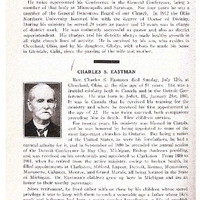
EASTMAN, CHARLES S.
Born 21 Jan., 1841, at J oliet, Illinois; died 12 July, 193 1,
at Cleveland, Ohio, at the age of 91. He was trained for
the ministry in Canada where he was sent for his first
church at age 22. During the next twenty years he served at some of the most important churches in Ontario. In
Sept. of 1880 Bishop Andrews receiYed Eastman into the
Detroit Conference .which was held at Bay City, Mi. .His
first appointment was at Clarkston and the second at
Milford where he preached for three years- 1881 82 and
83. From here he wem to Lapeer, Detroit, Romeo,
Menominee, Marquette , Calumet, ~1onroe and Grand
Marais .
His first wife, Maggie Jane Bailey, was the mother of
his five children. We did not find the names of the
children, bu t some may have gone or stayed at Ancoria,
Canada, where th eir grandparents lived and were buried.
Maggie J ane Bailey died in 1891 when he was at Calumet,
Mi. His second wife, Mary T. Gillan was born in
Philadelphia 15 Feb., 1848, and . died 29 Dec ., 1927 at
Chicago, III. They were married 16 Oct., 1895.
There were two things that were paramount in
Eastman S life-the history of the churches where he served and upholding the moral tone of the people with whom
he work ed. He wrote a detailed history of the Milford
Methodist Episcopal Church which was entitled "Essenjal Facts of the Milford Methodist church which he had
Jur Massam Pearson transcribe into our Official Minutes.
fhis was reported on 25 Feb., 1884 and for this we are
nost pleased to h ave. In this is given each person who
;erved in some capacity, the various groups who handled
nonies and is the most detailed report ever found.
1
A pape rback book which Eastman wrote in 1884 was
called. " The Danc.e " was printed by our local paper and
pa id for by our Offical Board. A copy of this may be seen
at the local Historical Society. He preached two sermons
using this theme in which he said ~hat dancing was a good
form of exercise, but The DANCE was to be shunned at
a ll costs. There was no count given on the n umber who
went to t he second of series! The signs show. that times
were alchanging, and by World War I, there was a different set o(values 't hat ministers dealt with.
.
Reverend Eastman also compiled t hirty-three sermons
by Methodist ministers who served in the southeastern
part of Michigan. This book is a sizeable one of 398 pages
with a picture of each minister. It was entitled.' 'Methodist
Episcopal Pulpit" v.}ith a copyright of 1897, printed at the
Monroe Commercial Printing House. Each sermon is about
twelve pages long-not as long as th ose found a hundred
years b efore. Our Methodist Church has a copy of these
sermons which h ad been bought by, Mrs. Charles Bourns.
There are sermons by two of our ministers- Reverend
Caster who preached from Matthew 27:32 and from
Reverend Washburn who chose 2nd Corinthians 4:2 .
Because E astm~n had asked James Potts, Editor of the
Michigan Christian Advocate to write an introduction,
this book is catalogued under Potts rather tha n Eastman.
Our local paper had irtformation not only about the times
wh en our subject was here, but followed him. when he
was at other places. In 1884 the paper of Sept. 7th noted
that the first two colored women, Elenor and Mary F;vans
were admitted to this church during Eastman's last service here . In 1885 Eastmans were given a purse of fortyfive dollars and a china tea set. In 1902 Eastman was
engaged in selling stock for the Great Northern Cement
Company. We presume that the product was good and the
company felt that his name was good for advertisement
purposes.
Our local newspaper gives us a feeling that the editorial
staff enjoyed Eastman S time here as much as did his congregation! Historians were left with the feeling that
Reverend C.S. Eastman worked faithfully to update the
previous histories and help us realize what he had done
in Milford. How wonderful that was and is!
1
1
I I
2
3
4
Notes taken from our local paper "The Milford Times."
Genesse County Democrat, Flint 26, March 1889.
Other notes taken from the Memoir in the Detroit Confernce
Annual Report.
46
�+--------------------~
67
- -----··- - - --- - THIRTY-SEVENTH SESSION,
fi\rs.
18!;12.
fi\a~~ie jaQe ~astmaQ!"'
Mrs. Maggie Jane East-man, only daughter of John J\1. and Ann
Bailey, and sister of the Rev. J. W. Bailey, of the Detroit Conference,
was born near the city of London, Ont., January 8, 1843. At the age
of seventeen years she wus ('Onvertetl unu united with the Wesleyan
Methodist church of that city. Her uniform and intelligent piety,
during these early years of her Christian life, was such as suggested
to all who knew her, a life ami sphere of special usefulness. On the
7th of April, 1864, she was married to the Rev. C. S. Eastman, whose
home she blessed and whose ministry she greatly strengthened for
twenty-seven years. Sixteen of those years were spent in Canada
and eleven in this stute. The charges served in this state, W\\re
Clarkston, Milford, Lupeer, Haven Church, Detroit, and Romeo, on
each of which she wlll be tenderly remembered by those who came
to know her well. For sixteen yean:! she was a sufferer from chronic
peritonitis,resnlt.ing in agf!ravated inflammation of the stomach, which
hecame the immediate cause of her death. Dnring all these years of
suffering, whh:h was often extreme, so uncomplaining and patient
was she, that few outside of her home circle realized how sore a
sufferer she was. It was often 11 grief to her that her semi-invalid
condition prevented her taking that active part in general church
work which she would otherwise hnve cheerfully done. But this
enforced lack of service was largely compensated by the uniform
sweetness and purity of her spirit, and her exemplary prudence in
all things. In all her as!lociation with the people of her charges, not
one word wus ever spoken which needed explanation or apology.
She never ofl'endcd with her tongue. Her virtues were qniet and
unassuming, and were therefore best appreciated by her family and
those friends who were near enougl! to her to diticern her true spirit.
She was strongly ,Jomestic in her tastes and interests. Never was
wife and mother more unselfishly and utterly ,Jevoted to the comfort
and happiness of husband and children, anrl never was one more
tenderly lovetl and deeply mourned. It is a rare thing which can be
eaitl of her: no memher of her family can recall anything in all her
domestic lifo, in deed, hearing or utterance, which leaves in their
mind any trace of regret. Thertl could scarcely be R more complete
ideal of wifely and motherly devotion.
For many months she anticipated a fatal termination to her illness, but there was no consternation ; it was a calm and tranquil
waiting. It was while asf!ieting in the work of packing, preparatory
to removRl from Romeo to Menominee that her strength failed, never
to return. After the shipment of their goods, by a s upreme effort,
she was removed to the home of her eldest son, in Detroit, in the
hope that a few weekH of rest there would flO far restore her strength
as to enable her to reach her new home. But it was a vain hope.
�68
.
;
·
'
DETROIT A NNUAL CoNFERENCE,
Scarcely had her husband met his new friends in Menominee, when
a telegram announcing that she was failing, summoned him to
Detroit. For somll weeks her death seemed daily imminent, and
then came a slight improvement. Bro. E118tman returned to his
work, and it Wll8 determined, in gratification of her in tense desire, to
remove her to Menominee. But, while waiting sufficient strength to
endure the journey, another relapse came, from which she did not
rally, and death ensued on the evening o£ Tuesday, DecemberS, 1891.
All the circumstances of her last illness and death-her home
broken, family divide(!, and long periods of anxious suspense-were
peculiarly pathetic and trying, hut were met with the uncomplaining
sweetness which was the life-long characteristic of her spirit.
Her dying experience was most blessed by assuring as to the fact
and reality of the heavenly life, and the power of the Christian faith
to sustain in the emergent hour. On the Sabbath before her death, in
the intervals of extreme suffering, sl1e was at times transport~d with
heavenly rapt ures. At one time, for more than half an hour, without
a pause, she sang of heaven, improvising both the words and tune.
The tones, which were perfectly pure and flute-like, were rich with
the unction of ecstasy; the tune a perfect melody ; the words in
poetic mell8ure, and the thought and imagery elevated and beautiful, and all through that scene of transfigurntion her face was radiant
as an angel's, and her hands moved in grareful and expressive gestures, as if guided by an angel's hand. It waa a sr.ene of special inspiration which banished forever from th e minds of those wh o heard it,
all doubt as to the triumph of the soul over death, a nd the reality of
the other life.
She was favored, during her illness, with the pastoml attentions
of the Rev. Dr. C. T. Allen and the Rev. Dr. L. P. Davis. Her funeral,
which was from the home of h er son on Fourth avenue, was in
charge of presiding Elder Hudson, assisted by Revs. Allen, Davis an<l
Shier, six other pastors of the city serving as pall bearers. She ie
resting perfectly in beautiful Woodmere, Detroit, leaving to her
family and friends the priceless memory of a pure and beautiful
character, and the sure hope of a glad reunion in th e land where
the pain-throb is never felt, and the separating shadows of death
never fall.
JI\rs. f'!arrlet
fl.
~alt.{ll')s.
'
Harriet A. Arms was born in Conway, Mass, April 4, 1826, b ut
came to Michigan when a child. At Brighton, May 31, 1848, she wns
married to Rev. Sylvester Oalkins who wns n probationer in t he
Michigan Conference and one of t he preachers on the Brighton
circuit. She fell asleep in Jesus on ihe morning of April 7, 1R92, at
.h er borne in South Lyon.
~~-------------------------------~
�160
DETROIT ANNUAL
CONFER~~CE
passing on the morning of November 29th. The Reverend H. R. Beatty died very
suddenly at Chelsea. some five years ago.
Cleo Culver, the only daughter of Levi and Helen Culver, was born December
4, 1877, in Leroy Township, Ingham County. Her early years were spent at
home. She taught school in adjact:nt school districts until August, 1899, wbc!l
she was united in marriage to Rev. H. R. Beatty, then assistant pastor of the
Williamston Methodist Church, Rev. N. N. Clark being the pastor. September
2nd of the same year they received their first appointment to Prescott, serving
successively and successfully to Pinconning, Romulus, Dundee, Grass Lake, Blissfield and Chelsea, where the husband died. They served in all, twenty-three
years in the ministry of the Methodist Church. Her family survive her. David
and Helen at home, Wayne of Lansing, and Howard of Ann Arbor.
The services were beJd in the church at WiUiamston on December 2nd aud ·
her body laid to rest by the side of her husband. The services were in ~
of her pastor, the following brethren assisting: Rev. S. ] . Pollock, and Ra.
B. A. Crampton read the scripture, Dr. Eugene Allen offered prayer, Rev. Alfred
Eddy, Rev. Hadley Bennett, Rev. Hudgens, and Rev. L. Ostrander assisted at
the cemetery. The bearers were Brothers Eddy, Hudgens, Bennett, Crampton,
Ostrander and Pollock.
"A wonderful being, a mother:
Other folks may love you,
But only a mother understands you.
When she leaves you-like a guardian angel
Her memory is always with you."
/MRS. CHARLES S. EASTMAN
Christmas joys still lingered as subdued echoes, and New Year was awakeaing new resolves when the celestial light broke upon the soul of Mrs. Mary].
Gillan Eastman, and her spirit arose to greet the land that is fairer than day.
The exact date of her translation being December 29, 1927.
Born in Philadelphia, Pa., on February 15, 1848, Mary T . Gillan started life
in the midst of traditions and historical associations that link godliness of
character and worthiness of pursuit to life and labor. On October 16, 1895, sbc
became the wife of our esteemed brother in the ministry, the Rev. Charles S.
Eastman at the time of his pastorate at Calumet, Michigan, and brought tht
grace of high christian womonhood and the devotion of a consecrated life to
the noble calling and home of a M ethodist preacher, sharing the burdens and
blessings of an itinerant life in the parsonage until 1901, when Brothe.r East·
man entered the retired relation.
Mrs. Eastman was the second wife of Brother Eastman, and leaves, in adlfi.
tion to her minister husbaiHf. one brother, Silas Gillan, of Milwaukee. Wis.
Death took place at Chicago, Ill.
�
 Eastman, Charles S.