-
Title
-
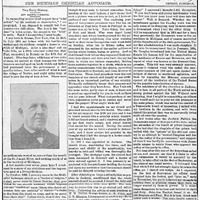
Clements, Samuel
-
extracted text
-
THE MIOIDGAN CHRISTIAN ADVOOATE.
Very Early History.
RRV SAllURL CLKidKNTS.
In responding to your kind request for a "brief
article" "of llfe incident or observat ion," I sm
perplexed. I am disposed to comply but I encounter two dtffimltles. The flr<1t ls the "incident" to write about, the second Is the "brief"
to write. But If I do anything I must begin.
I was born in Seneca., N~w York, O~t. 14, 1817.
In July 1825, my father with his fa.mlly-my
mother and six children-sought a. home in the
wilds of Michigan. After a. nine days' sail on
Lake Erie, on a. little schooner called the Fair
Play, we arrived in D etroit on the fifth da.y of
August. Five days le.ter, with team of two yoke
of oxen, we arrived a.t what b ecame our future
home- a marked spot on lands which my father
had purchased from the government a fe w
months before, four miles south of what Is now
the village of Dexter, and eight miles west · of
what is now the city of Ann Arbor. There were
no settlements west of ns, nearer than the month
of the St. J oseph River, and nothing south of us
in the territory of Michigan.
A few months over seven years later I awakened to a. s~nse of my sinfulness and the imperative need of a Dlvl.ne Saviour.
In October, 1838, I gave my name to the MetHodist Episcopal church as a. "seeker of religion."
I shall never cease to thank God for that provision tn our oburch economy which 1mpoaee
but one "condition" upon •·those who d esire admission into our societies" or classes-"a desire
to flee from the wrath to come, and to be saved
from their sins." I often think, that it this feature in our economy was given greater prominin our administrations, it would add greatto the interest of our class-meeting by bringinto them a. larger number of those who really
to learn something in religious experience,
DETROIT, SATURDAY,
though it ma.y seem to d etract somewhat from
heroism of the early father!!, I h ave to say that
such a picture was not true to fact, as I have experienced and observed. The exploring journeys of the pioneer preachers were Hke the exploration of Paul from Troas to Philippi in response to a. cry for help. Not a. vision, but men
of flesh and blood. Who were they? Local
preachers, men whoae h earts yearned for the salvation of their neighbors; who after working
hard on their farms through the week went forth
on Sunday, often ten to fHteen miles, and
preached in the cabins of the earlier settlers or
the log school houses, barns, or groves. And as
God blessed their labors they organized their converts into classes and then sent forth the cry for
help, to which our fathers responded, linking
these societies together in a. chain, whi"h in my
earlier acquaintance with the church, extending
from Plymouth to Marshall, and from Monroe to
Cold water. These local preachers were the real
founders of our church and largely of our clvlllzatlon in an Important portion of our country.
We hardly suffielently honor their memory a.nd
appreciate what thoy h ave done. May I not ask
the same noble, godly class of men, is there not
as great an opportunity for yon to work as there
was for your fathers? What v'a.st portions of our
rural population never go to church and never
hear the gospel? What ought we to dot
I had five appointments on my circuit and
preached at each once in two weeks. The estimate for my support was $100 per year and I was
to board around like a country school teacher.
I did not board around, and I received about $70
as my ft.rst year's salary, and about double
the.t a mont for the second. During the second
year of my service we built a church in Schoolcraft, a nd I have always felt grateful in tho
thought that I left the charge in a. better condition than I found it.
·
In 1857 I was appointed to Jackson. The
church there, considering the times, and the
number and ability of tho membership, was
h eavily in debt and withal was thoroughly discouraged. The mortgage upon the church had
b een foreclosed in chancery and a decree of
state entered a gainst it. I was personally acquainted with the gentleman holding the decree,
and upon my assurance that the amount should
be paid he delayed ordering the sale.
After obtaining as large a. subscription as possible in Jackson, conditioned that the whole
amount should be secured, I found the debt st1ll
nnprovlded for, a little over fSOOO.
The only
way to seenre this was to go abroad and solicit
h el p. Following the advice of such brethren as
W. H . Coll1ns, George Smith, A. M. Fitch, aud
C. T. Hinman, I determined to confine my Ptrorts
within our own conference if poSBlble. Money
then was not as plenty a.s lt has been since. The
largest subscription I obtained from any one,
outside of J ackson, was $25 and I obtained but
three of these. The average amount I obtained
doing?'' I answered I though t I did. He replied,
"If you don't keep still about this Sunday work
the first you know your head will drop into the
basket." Well, it dropped. W nether the remonstrance against the Sunday work was the
only cause of its dropping, may be more correctly determined when I tell the other thing. It
will be remembered that in 1854 and for a. long
time previously, the Democrats were in the as·
cendency in Michigan, and of course controlled
all the departments of the state government. U nder this administration I was made chaplain. It
will also be remembered that in January, 1854,
Mr. Douglas introduced into the United States
Senate hie famous bUl for the organization of
the territories of Kansas and Nebraska., and the
repeal of what was known as the Missouri Compromise. This bUl was very strongly opposed,
because it violated what was called the compromise measure of 1850 and again Olilened the
subject of slavery to continued agitation, and
then by r epealing the Missouri compromise
opened all the territories of the United States
to the possible introduction of slavery,
The ministers of all the churches in Jackson,
and in fact, in all parts of the North united in a
strong protest against the bill Without once
thinking, that I might be committing an o1fense
that would unfit me to pray for the prisoners in
the state prison, which was under the control of
a Democratic board of inspectors, I united with
my brethren in the ministry, and with them
signed the protest that was so universally being
made all over the country.
A few weeks after the Jackson Patriot, the
Democratic organ of that part of the state, called
the attention of the board of prison iwtpe,ct<Jrs
to the fact that the chaplain of the prison h ad
united with the "priests" of the city and
try in an attempt to "control Congress and d
tate the policy of the government," and sn lrlrEISted that 1t was hardly in accordance with JJetm4il·l•
cra.tlo usRges to retain those who opposed the
policy of the party in office.
Not long after this one of the inspectors called
on me, and assured me that if I chose to o1fer
my resignation 1t would be accepted by the
board, to take e1fect on the first of September, at
the close of one years' service. I informed
that while I dtd not strongly desire to retain
office, yet I should not resign. As I
on the first of September my official
dropped into the basket, and "later on,"
in November, the party followed my example
retlring from a poettlon where they were
longer wanted by those in power. It 1s
times dangerous to be true and faithful to
and duty. John the Baptist found lt so. So
did Stephen and Paul. But it is best. Good men
honor such a. cotu8e, Oar own hearts honor it
and God honors it here, and will honor it ror·RvRr.
�~gintothem a largernumberofthos~whoreally outside of J ackson, was $25 a nd I obtain~d but
ant to learn something in religions experience,
nd who want to tell somethiDg fresh and new
their own religious life. Then it would pub·
icly commit many, in their hours of seriousness,
to a religions life, who because nobody knows
anything of their serious feelings, afterward drift
off into the destructive currents of worldly, sensuone pleasures, down into the abyss of utter wreck
and irrecoverable rain.
Soon after my conversion I feU that a "dispensation of the gospel had been committed unto
me" and that it was my duty to preach the goapel. BeiDg of a timid and retiring disposition, I
felt this cross to be too heavy and determinedly
refuaed to obey. A very severe providential
visitation made me deeply feel the folly of an
absolutely dependent creature contending with
the Almighty. I finally submitted without reservation, and said with my whole h eart, "Not as
I will, but as thou wllt."
At a session of the Michijlan conference, held
at Adrian in September, 1849, under the pres!dency of Bishop Hamline, I was received on trial
and appointed to Schoolcraft circuit; in Ka.lamazoo county.
As the sketches yon invite, in connection with
the personal experience of the older brethren,
are intended to illwtrate tQ.e earlier history of
the church in this part of the country, a llow me
to digress from a. narrative of my own personal
doings and mention a matter which is belngoverlooked ver y largely in our reminiscences of the
earlier tlmes. I refer to the work of our local
preachers. In telling of the large circuits traversed by the pioneer pastors and the number of
their appointments and times they had to preach
in a month, or a round on their circuits, we do
not think to inquire how they came to know of
those appointments or places to preach. Or if
we think of it at all we think our pioneers were
a sort of prospecr.ors, and in our imagination follow them as they put a. change of linen for a four
weeks' service in t h eir saddle bags, and strapping
three booke together, the Bible, hymn-book and
discipline, mounted their horses a nd started out
like A.brab.am into an unknown country, following the track of the ptoneer's wagons or t he
blazes on the trees as they pointed out the wa.y
to the settler's ca.bin in the w1lderness. Now
three of these. T he average amount I obtained
from each application was about one dollar.
B ut by persistent effort, a fter t raveling a great
many hundred miles I succeeded in rataiDg the
required amount and paid the last dollar that
the chureh owed, as I now remember, in the
spring of 1858.
It is perhaps proper to say that the whole
amount pa id in for my support whUe I was doing this work, during the two years of my pas·
torate, did not exceed $220.
In September, 1858, I was appointed chaplain
of the State Prisov, and served the state in that
capacity for one year, on a. salary of $400. At the
end of one year I was superceded and relegated
to the p astora l work. I mention this fact because there are two things of which I would like
to s peak. One relates to the internal a dminist ra.tion of the prison, and the other to an instance of political party discipline.
At that time there were three m~nufacturing
contracts: a shoe contract, a wagon contract and
a contract for manufacturing farmiDg impie·
menta. The two laetnamed had a large amount
of machinery and tools that were of course constantly getting out of order. I found it was the
custom of certain designated foremen, every Banday morn iDg, to take such sklllfol men as they
wanted, from three or four to a dozen, with the
necessary keepers a nd guards to the shops to re
pair the machinery and tools and put them in
order for the next week's service.
As the moral and rellgioos instructor of the
prisoners I protested vigorously, to the internal
authorities of the prison against' this costom,
b ecause it violated the la ws of God and was sin
against him and his authority; because the men
needed the rest and were justly entitled to tt; to
deprive them of this was cruelty to them and
should not be done a.t the mercenary demand of
the contractor. Because it was a violation of the
Ia w of the state, a crime, and presented to the
world t he anomolous spectacle of the people's
criminal reformatory, itself a. criminal and exercisiDg its power upon t he criminals it restrained,
to make them commit additional crimes. My
protests were not saccessfol. On one occasion I
met one of the principal foremen in the yard a nd
he sa.id, "Clements, do you know what you are
I
�
 Clements, Samuel