-
Title
-
Cocker, Benjamin F.
-
extracted text
-
THE COMMISSION ON ARCillVES AND IDSTORY
DETROIT ANNUAL CONFERENCE
THE UNITED METHODIST CHURCH
Ronald A. Brunger, Archivist
Home Phone: (517) 456-7992
Archives, Adrian College Library
Adrian, Michigan 49221
Te lephone: (517) 265-5161
First Log Church
on the River Rouge
1818
Clinton, oldest UMC
edifice in Conference
1837
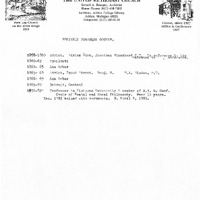
BENJ AfHN FRANXtLIN COCKER.
~858-1 86 0
Adrian .
1860-62
Yps i l anti
1862- 65
Ann Arbor
1865- 68
Adrian,
1868- 69
Ann Arbor
1869-70
Detroit, Centra l
1 ~70- 8 2 ~
drian Dis t, J ona than Bl ancha rd e n~.
p~ r .
c e ~t n his
r aneeNotr
o e feren
_ on
J. e rence.
B~o ad
treet.
~enfi .
F.
~.A .
Bl ades ,
P .~ .
Profes s or i n Mi chi gan Unive r s i t y ~ member of A. A. Q. Conf .
Cha ir of I·1ent al a nd Moral Philosophy . Ove r 13 yea rs.
Dec. l !i82 seized Ni th nn eumonia. D. April 8 , 1883.
�De~roit C o c; ~-o~'- ..... e
Methodist Ard1ive$
n t.:SH LIFE 1:'\ TASMA!I:1A
CHAPTER XI.
UISCO\'ERY OF COAL AT THE
~IER'>EY
-
SETTLE\I ENT AT THF. COAL
\11:'\ES- FOL':-;01:\G OF T ,\ RLETO:", TORQL'AY,
A:\0
FOR~IBY,
LA TROD E.
TnE story of early ~ett l cmcnt on the i\fersey will be interesting
to many. Strange as it ma y appear now, th at r iver was much
behind the Forth, Don, ami Port Sorell. There were flourishing
settlements at those three places in the year ISH, while for some
,·cars after th e l\Iersev was a lmm t a ~ silent and solitan· as it was
\1'11cn I first crossed {t in 1839. Pn.: ,·ious to the vea r l 850 there
was no land taken up at the :\fer,ey except l\fiss l\·fori arty's grant,
at Frogmorc. i\fr. Oldaker was the next to select land there. He
came to the colonv in 1850 ""ith a land order for 175 acr es,
which he ~e l ected ,~·ith a ri,·er frontage just aboYe T m·quay. No
tO\mship reserves had been made a t that period. i\'fr. Oldaker
could haYc placed hi s land order on East or \\'est Dc,·onport if
he had chosen to do so. How impossible is it to see a head! No
one would think, in those da ys, of selecting any of the townships
on the i\fersey, Forth, or Le,·en, for farming purposes, and th a t
is why the rejected patches were afterwards reserved for townships. !'\ow a frontage allotment is worth £1,000 an acre!
The discovery of coa l at this time (1850•) was the means of
attracting m any to th e l\!erscy during the two years following.
The first to develo p the coalfields was a gentleman, now living
o n his family estate, Pinkie, near Launceston . H e has an undoubted claim to be designated th e founder of th e Mersey settlement. That gentleman 's name is \ Villiam Boswell Dean. Mr.
Dean was a gia nt in those <la) S - physically as well as intellectua ll y. H e was always actin:ly engaged in pioneer work - always
prepared, if necessary, to do battle for the right. A firm supporter
of temperance and m ora lit y, and if need he, a bitter foe to mean·
ness and corruption ; for, if precept an d exam ple d id not keep
a man straight, he \vas not above trying the virtue of physical
fo rce by bringing into act ion th e powerfu l sinews of a strong
left arm. To Mr. Dean and Messrs. Benjamin and David Cocker
belong the honour of introducing a large number of active,
enterprisi ng colonists to the Mcrsey. But I must first proceed to
describe the coal discovery.
The first time I met Mr. Dea n on the coast was in April 1850.
H e was travelling in company with Mr. B. Cocker, from Circular
Head. He and his friend put into the Leven, and walked overland
from tha t place to the Forth, where they stayed with me fo r the
night. Mr. Dean had an interest in a community of splitters at the
82
vo
1
~.,~8~: ~~ -;:....~
() ~/ ~) w~) t
~e .___ lc?cf(
�DISCOVERY OF COAL AT THE MER5EY
I
Le,·en; and, ,,·bile there, !\Ir. Cocker preached from the text,
.. Come unto ~I e ", the first proclam~nion of this sort made in the
Le\'en Forest. Journeying onwards on foot fro m the Forth to the
\Jersey, these bold ad,·enturers struck right across the bush and
go t benighted on a tier near the Don; but, as fonune had it, they
discoYered the smoke from a splitter's hut, just at the time they
would otherwise ha \·e had to choose a ferny bed for the night. It
was with some misgi\'ing \fr. Cocker consented to approach the
hut, for he and his companion \,·ere carrying no less than £1,000
in their pockets. The shades of night were gathering around, and
!\Ir. Cocker, a new arriYal at the time, would probably ha,·e preferred to ha\'e gone to roost in the limb of a tree in that black
forest, rather th an trust his golti, let alone his life, to the doub tful mercy of the inhabitants of that ,·illainous-looking hut on a
lonely tier in com·ict \ 'an Diemen's Land. However, the buoya ncy of :\lr. Dean 's fearless spir it predom inated, and they made
for the hut. H ere they found two rough sons of toil, named
Powell and Ayres, whose occupation was that of splitt_i ng palings. They welcomed their visitors, anti ga,·e them such food
and lodgings as the rude dwelling could supply, with a fairly
comfortable bed for the night, all four in the only apa rtment,
with a big fire in the huge wooden ch imney at one end of the
build ing. i\l r. Cocker could not sleep that n ight. Visions of
severed windpipes and bruised skulls floated across the good
man's brain, when, abou t mid night, one of the splitters stole
gently out of his bunk, proceeded towards the door, anti
stealthily seized an axe in his hand as he went out into the
still, clark night. ~l r. Cocker poked his companion with his
elbow. ·· Dean! Dean!" he exclaimed, in a convulsive whisper,
"i t's all up with us, we're done men ; one fellow's gone out
\\'ith an axe." 1\fr. Dean was satisfied that no harm was brewing,
for he knew the character of the men who went splitting in the
lonely bush too well to suspect fo ul play ; besides, to take out
an axe looked less like an attempt to murder than to bring one
in. Presently Ayres came back with what looked like a huge
square log on his shou lder, which he placed on the fire. Mr.
Dean was very much astonished to see tha t th is log blazed like
coal, and he soon satisfied himself that it really was coal. In the
morning the men took Messrs. Dean and Cocker to the River
Don, and showed them where the coal cropped out, for which
service they were p aid five sovereigns, with injunctions on one
side, and promises on the other, to keep the affair secret.
The travellers hurried back to Launceston with specimens of
coal as quickly as the slow means at their command in those
days would allow them. Mr. Dean a t once .interviewed Mr. J.
W . Gleadow, Mr. J ames Aikenhead, and other friends, with
whom he discussed the question of securing the land, in view of
83
�BUSH LI FE IN TASMAN IA
,,·orking the coal. T en gen tl em en, includ ing Mr. Dean, j oined
th e undertaki ng, namel y, i\ fcssrs. \\'. B. Dea n, J ames Scott, .J.
\ '\'. Gleadow, .J. Aiken head, .J o hn Crookes, Tregurtha, \'\'cedon,
\ V. S. Buuo n, W. D. G rub b, a nd J. G . .J ennings. T hey purchased from l\Ir. Rob in ~on, the Black Pro tector, his locatio n
o rder for 1,700 a cre~ at lOs. per acre, and thus secured th e land
witho ut the risk of delay and com petitio n to which they would
be liable a t a sa le by a uctio n. \Ir. Dean procured the ser vices
of Mr. Zephania h Williams, an ex peri enced W elsh miner, who
was a t the time engaged in coal-mining work a t New Town,
nea r Ho bart. H e was fayo urab ly impressed with the Mersey
coalfield, and ,,·otdd haYe a ~s i s te d in deYeloping the mines, but
some of the syndicate wit h whom l\Jr. Dean \vas connected
declined to recei ve him . l\ lr. \\'illiam Dawso n, a forme r town
surYeyor, of Laun ceston, was a ppointed surveyor an d manager.
Th e work was carried on in an extravaga nt, costl y man ner;
and l\Ir. Dea n, seeing how m au ers \vere drifting, withdrew
from the syndica te, who now fl oa ted a company to work th e
gro und . Six bullock-dray loads of coal were ta ken from where
th e seam cropped o ut at th e Don, can ed over a n execrable bush
road to th e J\I ersey, a nd shipped by the cuuer Mountaineer to
Launceston, where it arri ved on February 25th, 1853. The public took up shares in the company. Experienced miners were
introduced from th e Home country; a tramway was partially
constructed to the l\l ersey, more buildings went up, and everythin g was conducted on a stupendo us scale. Ultimately the
workmen were flooded out of the shaft by a large body of
water, which, in spite of every effort to reduce it, necessi ta ted
its com p lete aba ndonment. T hen there was a deserted village
a t the Mersey Coa l Company's wo rks, and the shar es fell to nil,
after a n expenditure of £ 17,000 had been incurred.
In th e m eantime Mr. vV. B. Dean had formed a new company, in conjunction with Mr. J o hn Fawns, of Launceston, a nd
Mr. J am es Hurst, of Melbourne, to work a bed of coal on Mr.
J. Denney's land, Upper Don. They rented the ground for
£500 a year, constructed a tramroad, wo rking an incline o n the
Do n side with wire rope and a horse gi n. The ground was so
full of fa ults they had to th row up t_h e land, and Mr. Denney
was awarded £ 1,000 as compensa tion for non-fulfilment of the
terms of lease. This compa ny ra ised and exported a bo ut, 3,000
tons of coal the first year ; but the speculation resulted in considerable loss to Mr. Dean, his Melbourne partner having disappeared before th e affai rs of the company were adjusted. Mr.
Dea n th en sa nk a sha ft o n his own land between the Do n and
Dean's Point. H e shipped a quantity of coal, and a fterwards
let the mine to Mr. z. Williams.
84
�FOL':'\011'\G OF TARLETO N. TORf.!l ' A\' , FORMBY, ETC.
T h is ~u ited th e speculators ,·ery ,,·ell, lor the payments, and
the commencement of the term, \rerc to date from the time the
la nd was surveyed. Thus every one could sec their boundary
lines before they were required to pay a penny, so that those
who got a good block of land out of th e lucky bag kept it, and
those who were less successful in th e one-sided venture were
able to relinquish their claim without a ny loss. As might be
expected, all the known rich land round the Mersey was taken
up before the regulations were withdrawn, but it is a very
remarkable fact that the lan d fo r ten miles back at the Fo rth
and Gawler, known or unknown, good, bad, or indifferent, was
taken up before some of the choicest selections at the Mersey.
I remember o ne ca~e. A gentleman at Northdown wrote, ask ing
me to recommend him where to select two 500-acre lots of good
land at the Forth. I replied tha t a ll the land at the Don, Forth,
and Lc,·en was taken up for several miles back ; but I suggested
th a t there was land o n th e western side of the Mersey still
,·acan t, that I had on o ne occasion walked across it to the Don,
and found some good chocolate soil on a portion of it. The
land referred to was applied for, and secured - two lots of
500 acres each, now known as Appledore and Wenvoe. Land
was taken up in fa r-off, out-of-the-way p•aces before these
valuable sections were chosen. I took fi40 acres myself in North
Motton, away back from Manning's jetty, River Leven, long
before '"'envoe was thought of. So much for lack of foresight,
which is ever proving th e truth of the Ayrshire ploughman's .
verse: " T he best laid schemes of mice and men
Gang aft' agley."
As soon as the Surveyor-General saw the rush for land in
Devon, it occurred to him to form township reserves. Torquay,
Formby, and, later on, Latrobe, were laid down on the m aps ;
and when surveyors could be procured, some of the front
streets were marked off, and a llo tments surveyed for sale. Mr.
Isaac Stephens, ex-district constable of Port Sorell, built cottages
a t Torquay a t th e end of 1854, and opened an ho tel in the year
following. Mr. Tim Murphy was one of the first storekeepers
at Torq uay, but others opened about the same time, amongs t
whom were Messrs. Clerke & King, who opened the Devonshire
store, and Mr. George Dease a nnounced by advertisement in
the Launceston papers tha t he had commenced to sell general
ds a t Tent Square - 20th September, 1853. Mr. D. Cocker
ajready (in_l851) established_ the Liver oof-Stores at ...!'ili
south of Dean's Point ; and "in connecuon- with- h-i-s
-~~~~~l-;irl·
who had entered into mercantile pursuits in
'~
on the ] ohn Bull and Wave as ~egular traders
kinds of produce bought for cash, and advances made on
87
�BUSH LIFE IN TASMANIA
consignments to his brother. As a n instance of the sudden
advance in business matters at this period, I may repeat a
statement made at the time ; thirty sheep were slaughtered,
and half a ton of Hour baked weekly at l\ fr. Cocker's establishment.
Mr. J ohn D. Jowett took Mr. Clerke's store, and was appoint·
ed postmaster at Torquay on September 5th, 1854. Letters
posted in La unceston on Wednesday reached the Mersey on the
following day, via N ew Ground. Mr. Upton, also, was one o f
the early storekeepers. The police office was opened at the same
time, but headquarters were still ma intained at Burgess. Mr.
Richard H. Davies was clerk of the p eace, and 1\fr. R ya n
district constable. Most of the Government business and applications for public-house licences, were heard a t Burgess in
December 1854, much to the discontent of a large majority in
the district, lvho lived at the 1\fersey and far ther west. It is a
remarkable fact that there was not a road in the district, or a
road leading out of it, at this period. The Devon Road Trust
was in existence, but the district ex tended from the town of
Deloraine to Circular Head, and the trustees met at Delora ine;
Mr. W. H . Clayto n, of Longford, was road surveyor. On July
12th, 1854, Mr. Clayton advertised for tenders for clearing the
road from Deloraine to vVhitefoord Hills. This was the first
step taken towards opening a direct public road into Devon, in
place of the old bush tracks by Nati ve Plains, the Avenue, or
Badger H ead. The only cause that can be assigned for such
negligence on the part of the authorities is, that the Government of the colony was in a transition sta te at this period.
Roads will form the subject for a separate chapter. Steam
communication with Launceston was inaugurated in October
1854, when the ss. Titania began to run weekly to the ports on
the north-west coast.
·
Mr. Roger Winspear and Mr. J. H . McCall were amongst
the earliest residents at Torquay. In thus taking .iberty of
mentioning names, I wish it to be understood that I refer
personally to those only who were the early pioneers of the
district.
Formby was reserved for a township abou t the year 1853,
after Messrs. B. W. Thomas and C. S. Thomas had selected
their land to the south of that vacant spot, which fortunately
had not been taken up by any applicant under the pre-emptive
right. Morgan, the bricklayer and plasterer, was the first to
build a cottage on Formby. It stood back in the bush (in Fenton Street, I think) , opposite the Mussel Rock. Cap
Hedstrom (la te harbour master at Levuka, Fiji) was one
the first to buy an allotment at Formby. He built and
a general store, since occupied by the late Mr. W . Bennett.
88
�FOUt\'0 1!'\G OF
t
~
,
TAR LETO~,
T ORQIJA V, FORMBY, ETC:.
James Madden built the hotel \\'hich stands close to the railway
station. H e went there in 1858. It was afterwa rds p urchased by
the present owner, Mr. J ohn Reynolds, who resigned his
Government appoin tmen t and conducted it for a time, prior to
his removal to Sydney. But the first two buildings on the west
side of the r iver were two American cottages, erected by Mr.
Charles Thom:ts, on the \Venvoe estate adjoining Formby.
They were afterwards occupied by Mr. T. H ai nsworth, who
opened a school there. Mr. J owett, senior, purchased eigh t
acres on the hill from Mr. Thomas, fronting on Steele Street,
and also an a llotment with river frontage, where he built his
house. Mr. George Best followed , then Mr. J ohn Reeves, Mr.
David Best, and several others. Mr. B. W. Thomas also built his
house and went to reside at Appledore. There was a brewery
established at Appleclore under the management of Mr. Whitechurch, but it was closed when Mr. Turnbull started brewing
at Latrobe. Messrs. Beaumont, Carter, Lodge, Laycock, Roberts,
Raymond, a nd others whose names do not occur to me while I
write, ren ted and cl eared the scrub lands on Messrs. Thomas's
property. Mr. Robert Stewart came to the Mersey in 1854,
built his mill, and in other ways, which I sha ll refer to in a
future chapter, contributed materially to the advancement of
the district. Mr. Muggeridge was a nother of the early pioneers ;
and some there were whose names I have omitted from forgetfulness ra ther than design .
While the Mersey was thus going a hea with giant strides,
between _the .,.y_ears 185 1 and 1855,_ its pmgress was greatly
marred by the niggardly policy o( the Government. - Its commercial rela tions with Port Phillip and the sister colonies just
at tha t period afforded brillia nt prospects in the way of an
intercolonial trade; but vessels coming to or leaving the
Mersey and other rivers, had to call at Circular H ead for a
Customs clearance. Messrs B._and._D. Cocker put four vessels
in the Melbourne--t-rade - the bark A nthracite, the brig Wave,
and the schooners j ohn Nassey and Freebridge. In addition to
thf' Customs difficulty, the insurance offices would only insure
to the mouths of the ri vers. The ship pers and owners were
obliged to enter a t their own risk. In order to prove to the
various companies that the Mersey was safe and navigable, Mr.
W. B. Dean chartered the ss. Fenella, of I ,000 tons burden, and
gave his bond for £2,000 to cover a ny d amage she might susta in
when going in a nd out. This condition of affairs could not, of
course, last long. A Custom house officer (Mr. Rankin) and a
ilot (Mr. Wigmore) were a ppointed about the year 1855; but
was after the extra-ordinary demand for timber in Melfor house-building had subsided, the Americans h aving
the market. It would be ou t of p lace here to discourse
D~ ~~ -~?-~~ ~!f'-56- Iii
89
�II USH LIFE 1!\
TA S~lA !\IA
upon the marvellous prices r uling for hardwood in 1 85 ~. b ut I
intend to devote a chapter sp ecial ly bearing on the subject.
Latrobe is the youngest townsh ip on the ?\l ersey. The la te
.M r. George Atkinso n bui lt the first ho use there. I t was a
modest wood e n building in Gilbert Street, whe re Lucas's H o tel
now stands. l'v! r. Atkinson had succeed ed l\fr. Kin g as landlord
of the in n at .Ballahoo. but he decided to build at La trobe. and
take o ut a licen ce for his new house. H e first t hough t of bu ild·
ing d own the riYer a t a d eep w;llcr lrontage, ,,·here !\lc:.srs. Bell
and Ik n ti nck had just erected stores to rccei YC produce Irom
Dunorlan, but the keen foresig ht of ;\ l r. r\tkin ~o n kd him to
decide intelligen tl y, and so it w;ts that the Father of Latrobe
built in G il bert Street. T he next resident at Latrobe was l\ lr.
T urnbull , who erectl'd a brewe ry and dwelli ng-house across
King's Creek, on the ba nks of t h e riYer. Thus Latrobe started
with a public-house and a brewery. lloth were we ll conducted ,
a mi a decided benefit to th e distrin, the one al fording excelle nt
accommoda tion to tra ve llers and p erso n s in search ol la nd, and
the o ther providi ng a cheap a nd rat he r harm less beYerage for
the inhabitants of the district who were n o t absolu te teetotalers.
I h ave not got the date o f the lirst Lat ro be land sale, but the
second was held a t the Co urthouse, Launccstou , o n 1\lay 20th ,
I HSH. The Gilbert Stree t lo ts adjoi ning 1\ Ir. Atkinson's, and a ll
on th e opposite side ol the !>tree t, were still un sold. T hey were
o lfcred o n th e a bove date in two-acre lo ts for £17 15s. each !
1 shall not a ttempt to d escribe how Latro be sheered ahead
afterwards. It soon became a commuu ity of shrewd , self-reliant
men o f busi ness, and at o ne time seemed likel y to monopolise
th e whole trade of East De\'on : but as po pulatio u became
more dense in the v;n·ious p;trts of th e di stri ct, loca l wants were
suppli ed from loca l soutn ·s. l\L11t y o l th e old o riginals ;tre still
ali ve and prospering at La trobe.
To those who know the dillin dti es encoutlle rcd by the earl y
inhabitants of La tro be, it seems man·cllous that they were able
to withstand the tlltlllerolls obstacles t hat imped ed their pro·
g ress. They were c ut o lf from ove rla nd conun uni cation with
o th er parts o f the colony until , at a comparatively recent date,
the au thori ties thoug ht p rop er to m ;tke a road to Dcloraine.
Even so la te as the year I H7!J th e ro;nl to Dcloraine was a
dangerous bog in some places. I 11 th e spring of that year I was
travelling in Hewe tt's coac h with 1\ l r. ll raddo n, th e newly
elected m ember for vVcst Devon, w hen in o ne spot, where a
stump had been grubbed, o ne o f th e ho rses disappeared, all
but his head an d sh o uld ers. We had all to lend a hand t
extricate the poor a nimal. T he road being a sea o f slush, no
o nly there but for miles farthe r, the condition of the coach
90
�FIRST CHURCHES IN DEVON
CHAPTER XIV.
FIRST CHL'RCHES IN DEVON
Mv present chapter I intend to devote to early Church movements, and personal reminiscences of a few who were connected
therewith . The first place of worship belonging to the Anglican
Church was built at Northdown in (or about) the year 1848,
upon land given for the purpose by Mr. S. H . Thomas. Bishop
Nixon and Archdeacon Davies visited the district in 1849, and
appointed lay readers in the vario us places. A church was built
a t "The Hermitage", New Ground, on Mr. Shaw's land. The
Rev. M. Wi lliams, of Deloraine, held occasional services at those
places fo r a time, and the Rev. John Bishton, who h ad resigned
his cure at Westbury and had gone to li ve at Pardoe, rendered
ministerial aid in the early days of the Northdown Church. The
Rev. Benjamin Ball was nex t appo in ted as resident clergyman,
with a stipend from the Ripon Fund. The bishop and archdeacon
were most attentive to the spiritua l and ed ucational wants of the
district. His lordship preached at Torguay, Tarleton, and in the
Forth Chapel in November I 854. Mr. Ball having resig ned as
resident clergyman at Northdown, the Rev. E. P. Adams (now of
Westbury) succeeded him in February 1857. Thenceforward the
Episcopa l Church made headway on the coast.
The Wesleyans were the first denom ination to move in Church
~ters at the Mersey. Jn August 1853 Mr. Brown, who was con\nected with the coalmin es, and had been a Methodist local
lJreacher in England, got the people together on the Sundays.
1H e preached his first sermon in the open a ir from the text, "I
am the vi ne, ye arc the branches··. This gentleman 's son was
afterwards a minister of the same Church, and was resident at the
·Mersey in the year I H71'i. Sim ultaneously with Mr. Brown's
praiseworth y efforts in preachi ng the Gospel at the coalmines
and at Cocker's Point, Mr. Swift opened a Sunday School, wh ich
was of great benefit to the hitherto neglected children at the
Mersey. Mr. Swift was a gentleman whose chequcred life was a
sad example of the J reaks of fortune iu the cases of many who
had been unsuccessl ul at the gold diggings. He came out from
Engla nd to Port Phillip in his own ship to dig for gold. The
ves~cl was wrer:kcd. Mr. Swift so ught to recover his fortunes on
the goldfields ; instead of which he ~ent backward, until at
length he became absol u tely penniless. In this condi tion he tried
) to obtain a livelihood at a very humble occupation in Melbourne, where he met Mr. B. Cocker and Mr. B. Dean. The
121
�B USH LI FE IN TASMA N IA
Ia u er arranged with M r. Swift to come to the Meney as bookkeeper, a capacity more suited to his su peri or training. Mr.
Cocker also m et in Melbourne an emin ent Wesleya n d ivine from
the United States, who had Leen led b y some unacco untable
halluci na tio n to the goldfields o f A ustral ia, where, like Mr. Swift,
h e was u nsuccessful. This was the R ev. Edward 1\•fcCiure. Mr.
Cocker befriended him and sent him across to the M ersey, to be
p rovided for by Mr. D ea n and his bro ther, Mr. D av id Cocker. I
shall have mo re to say about l\ fr. McClure later on. T he first
\<\'esleya n minister placed a t t he i\fersey b y the Government
a uthority o f the Church was a ;\1r. Luff. H e arrived a t the
Mersey o n Februar y 17th, 1857, b ut was dismissed from all connection with the Church shortl y afterwards. His successors were
men who soon r estored the C h u rch to its p roper standard, and
imparted confidence in their m inistrations. The \<\fesleya ns in
D evon , as elsewher e, ca rried o n t hei r aggressive system with grea t
-success, spreading o ut branches in man y localities th a t had been
neglec ted b y o ther Churches, and also establishing themselves in
older centres where o ther Churches alread y ex isted.
The Congregatio na lists were, however, far in adva nce of all
the o ther d eno mina tio ns in administering to th e spiritual wants
of the district. I h ave to uched upon this subject in a previous
chapter , wherein I gave a brief account of the R ev. William
W a terfield's missio n work a t the Fo rth in 1844, and for some
yea rs fo llowing. The first Independent Chap el was built in the
la tter part o f 1844. It stood in the centre of that ground which
holds the r emains of m an y of the first inhabitants, many who
left fond hearts behi nd to mo urn o ver memories th at will endure
until friend m eets friend once m or e in the spirit land . The
chapel gro und unfo rtun a tely had no t been clear ed o f ~evera l tall
for est t rees before the building was erected , a few o f which stood
within reach of the edi fice, b ut none leaning towards it. H ad any
o f these fallen under o rd inary circumstances they wo uld h ave
gr avitated in som e o th er directio n ; but t here was a vio lent gale
·o ne aftern oon in th e ea rly part o f I 815, a few mo nths after the
opening o f the cha pel, when a large tree was blown up b y the
r oots ami fell across the cen tre of the b uild ing, completely d estroying th e larger po rtio n. There was a nea tl y constructed
pla tform and readin g d esk, with the chu rch Bible a t one end,
which quite escap ed wreckage, but m os t o f the comfortable seats
were sm ashed ; so tha t, h ad the tree com e down during service
time, it wo uld have been a bad jo b fo r those early settlers of the
Forth and their families, nearly all o f whom were regular attenda nts. The trees were soon all felled and the place rebuilt by
willing hands, the L auncesto n committee of the Colonial Missionary Society assisting, as th ey had done before. The nam es o f
the active members o f that excellent committee should be
122
J1
J
t
~
~
�
 Cocker, Benjamin F.