-
Title
-
Cookson, Frank H.
-
extracted text
-
'
�FRANK
H
COOKS ON
1 8 7 4
AutobJ_ograEhY
-oIn a typical English countryside called CheadleHume in the county of Cheshire, England, I was born
April 28, 1874.
In regard to ancestry, I have no
genealogical knowledge, other than that which begins
with my father, Frederick Cookson, whose birthplace
was Tarporly, Cheshire
~ounty,
England.
My mother
was born in England and her maiden name was Elizabeth
Harris, but of the date and place of her birth I am
ignorant.
My father was affiliated with the Church of
England and employed in British Government service.
He was appointed to Hong Kong at the time I was a
young child.
In 1884, the year that I had reached
the age of ten, an epidemic of Asiatic Cholera swept
over the Island with devatating results and ended
abruptly my boy world.
The memory of those tragic
days have lingered through the years.
everywhere, few formal burials.
Death was
Within a week,
father, mother and sister were its victims and I
became the temporary Ward of the government.
During
the same year legal arrangements were made for my
•
�z
future care and I sailed for England.
My father's
oldest brother John became my legal guardian,
financial provision having been made for my maintenance and education; the full benefit of this provision I never received.
After the death of my parents, on my return to
England, I became acquainted with my father's surviving brothers - Joseph was a Baptist and a fervent
crusader in the "Blue Ribbon 11 temperance movement.
John, my guardian, was a Congregationalist.
Both of
my uncles were Department Superintendents with the
London and North Western Railway Company; William was
a Horticulturist and a Wesleyan Local preacher, highly respected for his ideals and Christian character.
He gave forty years of voluntary service on the
Manchester District.
Apart from these family con-
tacts, I have no information respecting their sires.
Long separations from these kinsfolk lost me the opportunity of gathering information I might have
learned relative to family history, had I at the
time, been curious in regard to the matter.
A vivid remembrance of my first introduction to
my guardian's home remains.
It was wash day.
scent of soap suds was in the air.
The
Instinctively I
felt that my future relation with my incle's family
�3
was not going to be a happy one.
In
subseq~ent
years, I came to understand why Charles Dickens hated
the odor of the blacking factory.
What education I have gained was attained the
hard way,
Circumstances and a conjunction of cir-
cumetances cheated me of the opportunity to pursue
a regular school curriculum, which has been a life
time regret.
During my residence in Hong Kong, I
attended a Roman Catholic Parochial School.
Return-
ing to England, I enrolled in the Public School and
continued until 1887.
During this year, my uncle
and his family moved to Liverpool and I took the
occasion to leave.
This adventure in self support
brought many challenging experiences.
The pittance
I received for wages involved many sacrifices which
I should never have been called upon to make.
Life
under the pressure of these early adverse years took
on sombre hues.
concerting.
The complexities of life were dis-
The seeming contradictions and incon-
gruities of things baffled me.
There were times
when I was seized with the emotional fervor of a
reformer and would pledge myself that someday I
would articulate all I felt and thought in protest
against what seemed to me the selfishness and
injustices of life.
However, these struggling
�4
years did something for me.
The winter of 1890 marked an important turning
point in my life.
It was attained by attending a
widely advertised evangelistic service in the city of
Liverpool.
The evangelist was an Australian who had
taken part in the California Gold Rush in 1849.
He
told a stirring story of his life and conversion.
That night I dedicated my life to the will of God.
This decision marked a new outlook on life for me.
It awakened new interests and focused my mind on new
objectives.
A passion for the acquisition of
knowledge gave me a new appraisement of time.
Zeal-
ously I gave myself to study and wide reading.
Immediate affiliation with some church did not
occur to me at the time.
Uniting with the Methodist
Communion was not because of any doctrinal conviction
but rather that of association with Methodist
friends.
The impulse to give expression to my ex-
perience and
co~victions
was the compelling urge
which led me to launch alone as a preacher of the
gospel of Christ on the street corners and public
squares of Liverpool.
This voluntary evangelistic
venture I carried on for almost two years.
In 1891 I entered a Wesleyan training school in
Rochda le, now known as Cliff College.
In 1894, I
�5
was sent to Canterbury to continue a series of
Evangelistic Services that had been interrupted by
the illness of the
At the close of
ev~ngelist.
these special services I was employed as District Lay
Preacher on the Canterbury District for the purpose
of consolidating the gains of membership by organizing Methodist class groups and visitation.
In the spring of 1896, I sailed for America,
with Michigan as my destination.
In Akron, Michigan,
I met Arthur Richards, who had been one of my Liverpool friends.
He was working on his conference
studies and asked me to stay with him a few weeks and
help him in his church work.
In the early summer of
that year we organized a Grove Meeting.
meeting I met many visiting pastors.
At this
Before the
close of this meeting t had made some evangelistic
engagements and continued in E¥angelist1c work on the
frontiers or Michigan for the next two years.
On
two occasions I served as supply pastor in Clifford
and Minden City until pastors were appointed.
Closing a series of meetings, the last of which was
Elkton, I suffered a break in health that necessitated rest and care.
Providentially, a friend generous
ly offered me the hospitality of a farm home and afteJ
a few months of rest, offered me financial backing in
�6
any enterprise that I thought could be successfully
carried on.
At that time the Canadian government
had thrown open the frontiers of the Northwest for
settlement.
I arranged a three months trip and
traveled as far as Edmonton.
Resulting from this
trip was the purchase of a sheep ranch located fourteen miles South of Medicine Hat .
In the summer of
1902, I sold the ranch and returned to Michigan, paid
back the money I had borrowed at six per cent whi ch
was loaned to me at four per cent.
In September I enrolled in the Ferris Institute
with the intention of seeking admission in the Michigan
Conf~rence
in the autumn of 1903.
A week after
my arrival in Big Rapids, Dr. Masters, Presiding
Elder of the Big Rapids District, asked me to supply
the Shepherd Charge on Sundays until he could appoint a pastor.
In October he insisted I take the
charge and move on the field immediately.
The
following December, I was united in marriage with
Agnes Wolfe of Hudson, Michigan.
She was the
daughter of Mr. and Mrs. David Wolfe.
In the autumn of 1903, I was admitted on trial
in the Michigan Conference.
In 1904 I was ordained
Deacon by Bishop Charles McCabe in Grand Rapids, receiving Deacon orders one year earlier, which was due
�7
to taking local Deacon examinations in addition to
my conference studies.
In 1907, I was ordained
Elder by Bishop William Fraser McDowell in Albion.
At this session of the conference I was appointed to
Union City.
In 1910, I was sent to Plainfield
Avenue, Grand Rapids.
In 1912, Bishop Burt asked
me to go to Porto Rico and appointed me to Trinity
Church, San Juan.
This appointment was for special
plans that were under consideration by the Home
Mission Board.
Disagreement in the Board
resu~ted
in a change of original plans for which I had been
appointed.
By request, I was transferred to the
Detroit Conference for an appointment.
In 1914, I
was sent to Lake Linden; in 1917 to Escanaba; in 1919
to Bad Axe.
In 1922, I was appointed ' !strict
Superintendent of the Saginaw-Bay District.
In 1928
I was appointed to Monroe, and on March 12, 1929,
Mrs. Cookson unexpectedly passed away.
For twenty-
six years she bravely shared the vicissitudes of our
itiner~nt
ministry without
reg~et
or complaint.
The
'
changing fortunes of the unfolding years were never
disturbing or exaggerated.
in the trying hours.
Her faith never failed
Whatever the test, it was met
with fortitude as incidents that were providentially
linked with some waiting good in our unseen tomorrow.
�8
She moved among us with a quiet dignity and .from her
rich inner life
ema~ated
was always assuring.
a spiritual atmosphere that
Loyalty to her family and
church was as constant as the North Star and to both
she gave the full measure of her strength, love and
devotion.
To our union five children were born: Rosalyn
Arbutus, a school teacher residing in Kalamazoo;
Leonard Theodore, married to Rhoda Upjohn and employed by the Upjohn Company in Kalamazoo; Sylves·ter
Ulysuss, married to Hilda Baumeister and e111ployed by
the Ri ver Raisin Paper Company, Monroe; Marjorie
Irene, married to John Currie, residing in Detroit;
Frank
~erbert,
now serving in the American armed
forces.
The passing of Mrs. Cookson left me feeling
like a man in a boat on a rough sea with an oar-lock
missing; and the realization that failing health was
breaking down my efficiency did not make
~ighter.
~he
burden
In 1931, I was appointed to the Whitfield
Avenue Church, Detroit.
In 1933, I asked for an
appointment with less responsibilities and Durand
became my last conference appointment.
Nervous
exhaustion and other physical disabilities compelled
me to ask for a superannuated relation in 1935, after
�9
forty-five years of preaching the gospel of Christ,
thirty-two of which were given to the pastoral care
of churches.
I have been affiliated with the Mas onic Fraternity for thirty-two years and served as Grand Chaplain
of the Grand Council of the State of Michigan for
thirteen years.
October 19, 1935, I was united in marriage with
Lois Steele of Rock Hill, South Carolina, the grand
daughter of Dr. Samuel L.yle Watson, who for forty
years was pastor of the Bethel Presbyterian Church
in York County, South Carolina.
He served a major
roll in the religious life of South Carolina during
a period before and after the Civil War.
And now in
the evening of life with companionship, domiciled in
a bungalow among the palms and sunshine of Tampa,
Florida, we watch the panorama of events in a rapidly
changing world with all the tragic happenings of our
time.
Ye~
sustained by a confident trust that God
will take care of His world and with a growing faith
in the verities of the gospel of Christ to which we
commit ourselves in mental and moral confidence.
(The foregoing was written in 1942).
�
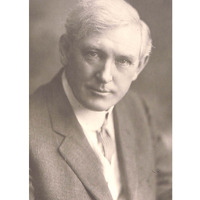 Cookson, Frank H.